My Lemon Cheese Cake ©
“Happy Name Day” To Nick In Madagascar and Henry J. and I. this one is for you !
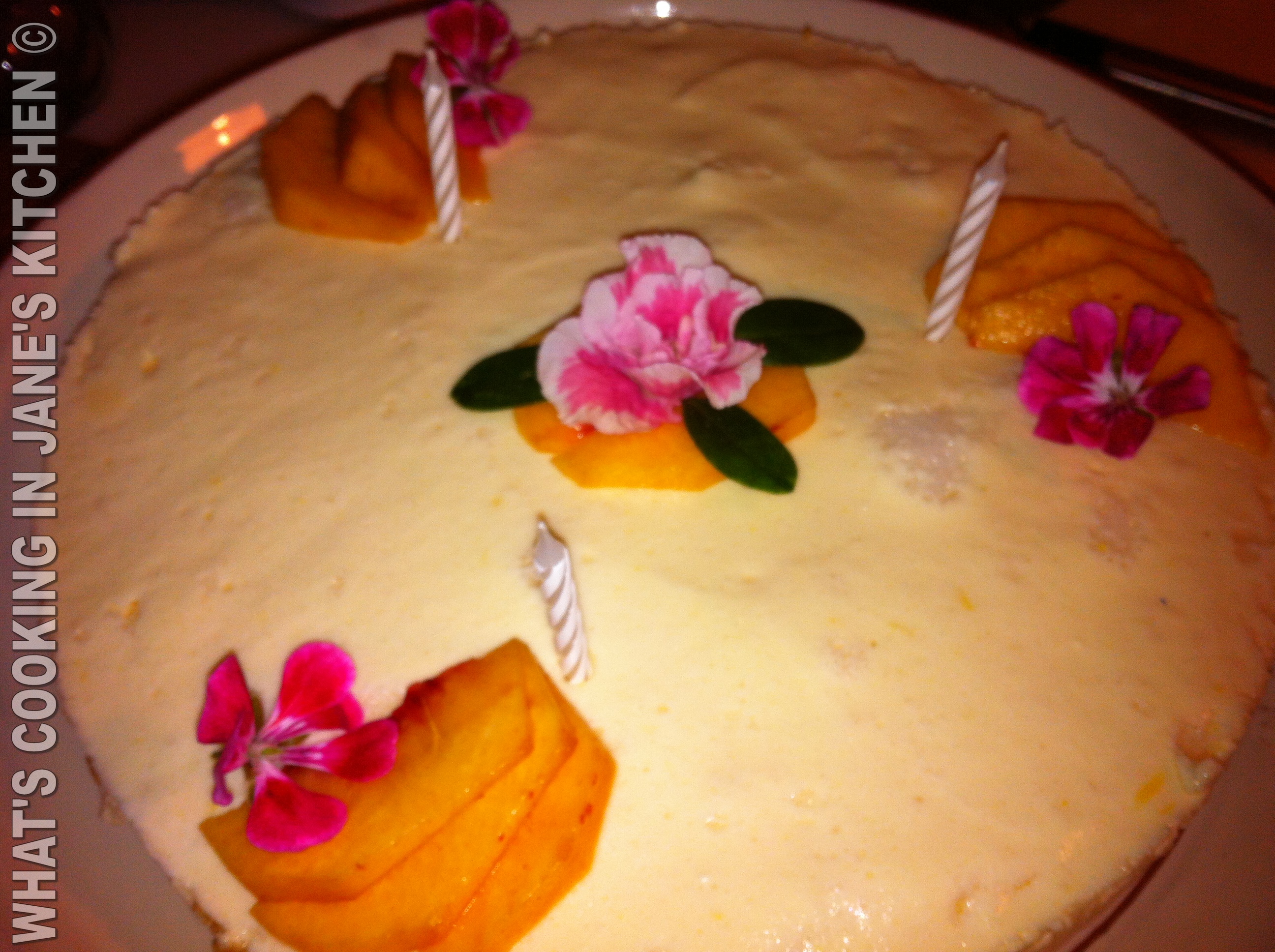
More advanced, but definitely worth a try and once made, it is easy the next time. My children made it for
my Birthday this summer, such a treat and it was excellent !
12 Persons
Ingredients
4 egg yolks
4 egg whites
175 g sugar
8 leaves of gelatin ( 13 g )
2-3 tbs water for softening gelatin
1 large lemon juice and zest
400 g Cream cheese (Philadelphia )
Pinch salt
200 g McVitie’s/Papadopoulos digestive biscuits ( 1/2 pack )
200 g carton of thick Greek yogurt. I use ‘Fage Total.’
50 g melted butter
Fresh fruit and glacé cherries for decoration
Special Equipment
1 spring bottom cake tin, diameter 25 cms
Method
PREPARATION :
In this recipe, as with every recipe, it is essential to get everything you need out and ready, before you start cooking, it uses several pieces of equipment!
Important! Ideally make the day before, otherwise make in the morning for the evening to give time for the gelatin to fully set.
1. Take your spring bottom cake tin and release the spring so that the bottom comes away. Now turn it over to the smooth side, where there is no lip and close the tin up again. This ensures you being able to slide the cake off the tin base, onto your serving dish once you have finished.
2. Place your tin on a sheet of grease-proof paper and draw round with a pencil. Cut out the circle and lay on the inside base of your tin.
3. Melt butter in a small saucepan and in the mean while place the biscuits in the blender and pulse until fully broken up. If you do not have a blender break up the biscuits in a pestle and mortar, or place in a strong plastic bag and bash with a rolling pin or glass bottle.
4. Empty the biscuits into a bowl and add the melted butter. Mix well and place in cake tin. Press down evenly and flatten out with a large spoon.The flatter the better, or the biscuit will look uneven when you cut the cake. Place in refrigerator until ready to use.
5. Separate eggs, put whites into a large bowl to allow plenty of space to beat them, put yolks into a smaller bowl along with half the sugar and put the cream cheese into a large enough bowl to hold all the cake mixture, once you are ready to fold it all together. Add to the cream cheese your finely grated lemon zest, grated on finest holes of grater together with the yogurt . Squeeze lemon juice and pass through fine sieve, into a glass.
6. Place 2-3 tbs water into a small saucepan and add gelatin leaves one by one so that the water gets in between the leaves. Leave to soak until soft and wrinkly, about 5 minutes. Turn over gelatin if necessary so that it is all soft. At this point there is no hurry to use the gelatin.
Up until this point, I call the preparation part. From here onwards you start assembling your cheese cake and want to continue until you finish!
ASSEMBLING CHEESE CAKE
8. First, mix together your cream cheese, finely grated lemon zest and yogurt, using a whisk, until it is completely smooth, no little lumps!
7. Second, beat your egg yolks and “half” the sugar with a whisk until they are double the volume and very light in color. (5 mins) This adds air and lightness to your cheese cake and is an important factor.
9. Third, remove the beaters and wash under hot water, together with soap until spotlessly clean. Dry carefully and beat egg whites with a pinch of salt, until stiff peaks. ( This means the egg whites stand up stiffly, when you lift a little egg white with the beater. ) Now add the remaining sugar and beat again until shiny, about three minutes. (See N.B. bottom of recipe.)
10. Fourth, melt the gelatin over a low heat, it should ‘not’ boil, until it is completely dissolved. Remove from heat and add your lemon juice. Using a fine sieve pour onto egg yolks and mix together. If it does unfortunately boil, it will not work so well, throw away and start again. The end result of this cheese cake gives no clue that gelatin has been used.
11.Fifth, Add egg yolks to cream cheese, whisk together .
12. Finally, fold in two tablespoons of meringue at first and then the rest in two goes, cutting across your mixture, lifting and turning over, giving your bowl a half turn each time, until the mixture is just amalgamated. If you fold too long you will lose volume and lightness.If you over fold you push out all the air you have beating in.
13. Turn your cheese cake mixture out in one, into your tin and very lightly smooth over the top. Cover with tin foil and place in refrigerator for at least four hours to set.
14. Once the cheese cake is set, remove from refrigerator. Run a knife around inside of tin, right down to the bottom, so that the biscuit does not stick to the sides of the tin.Place tin on work top, release spring surround and hold base on the side of a suitable serving dish at an angle and with the help of a spatula placed ‘under’ grease-proof paper, very gently push the cake so that it slides onto serving dish, leaving you holding the metal base.
15. Decorate with fresh peaches, added just before serving, so that they do not brown, glacé cherries and edible flowers. ( Brush the peaches with a little lemon juice, before hand to stop them browning.)
N.B. Egg whites require a spotless bowl and no egg yolk accidentally dropped in order to beat up into meringue, any grease on bowl will also not allow this to happen. Should the telephone ring, give them an extra beat again, just before folding in, as they loose their volume easily.
No worries about “Gelatin!” As long as you don’t boil it, you sieve it, so that you don’t come across any lumps while eating and you work continuously with out stopping, once you have added it, all will be well. If you are called away and the gelatin begins to set, no amount of beating will get your mixture smooth. I am mostly making this in a hot kitchen in the summer time, so the gelatin gels slower, but even in winter, it has never set before I have finished.
This is a delectable cake, lemony light and not a hint of gelatin, which is as it should be.
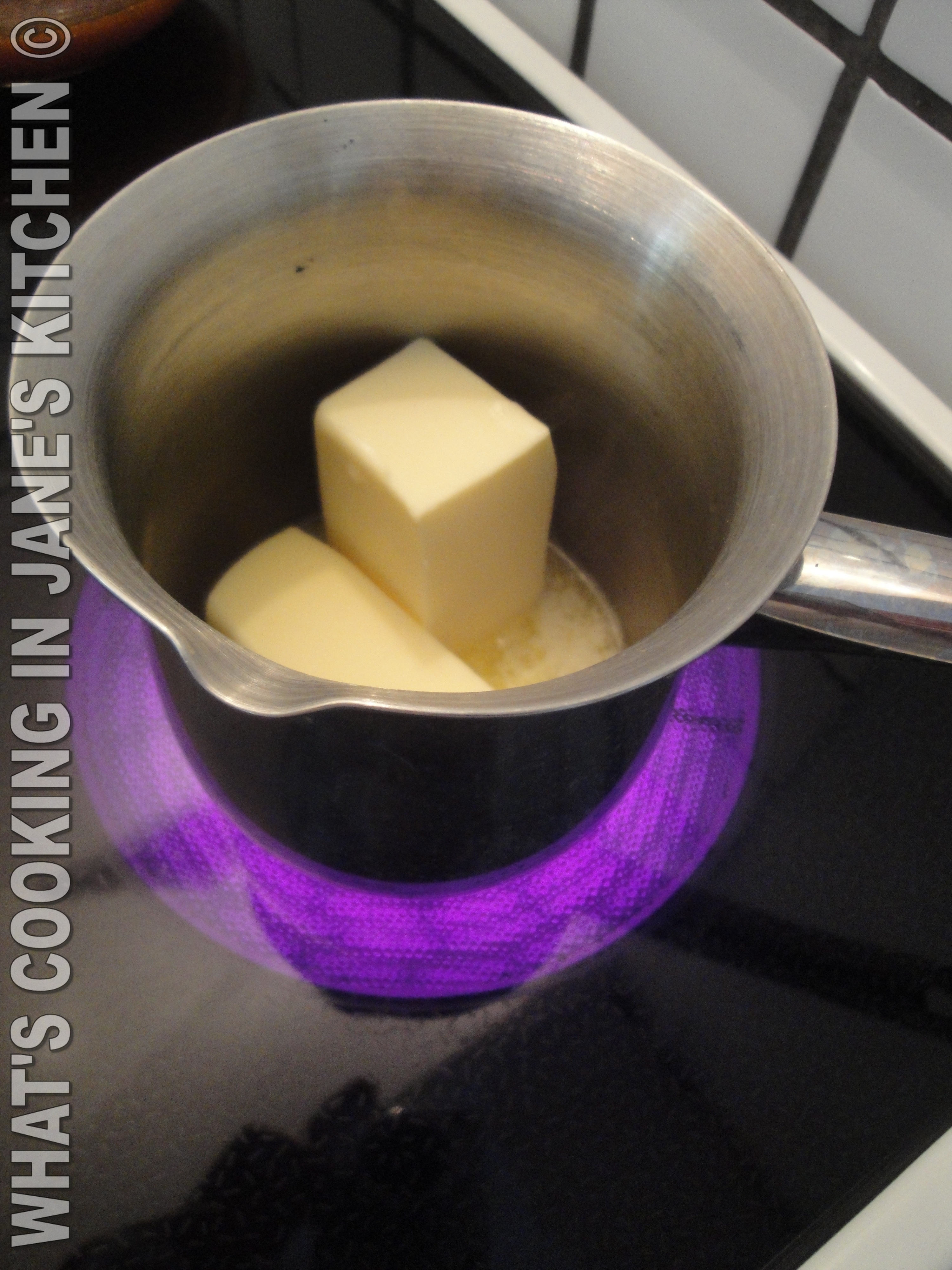
Having prepared your tin,( see recipe,) melt your butter in a small saucepan.
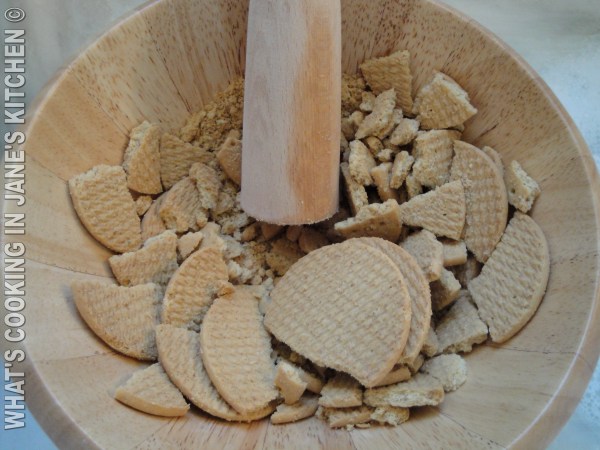
Break up biscuits in a bowl, using blender or plastic bag, with the aid of a rolling pin to break up the biscuits.

Biscuits should look like this once broken up.
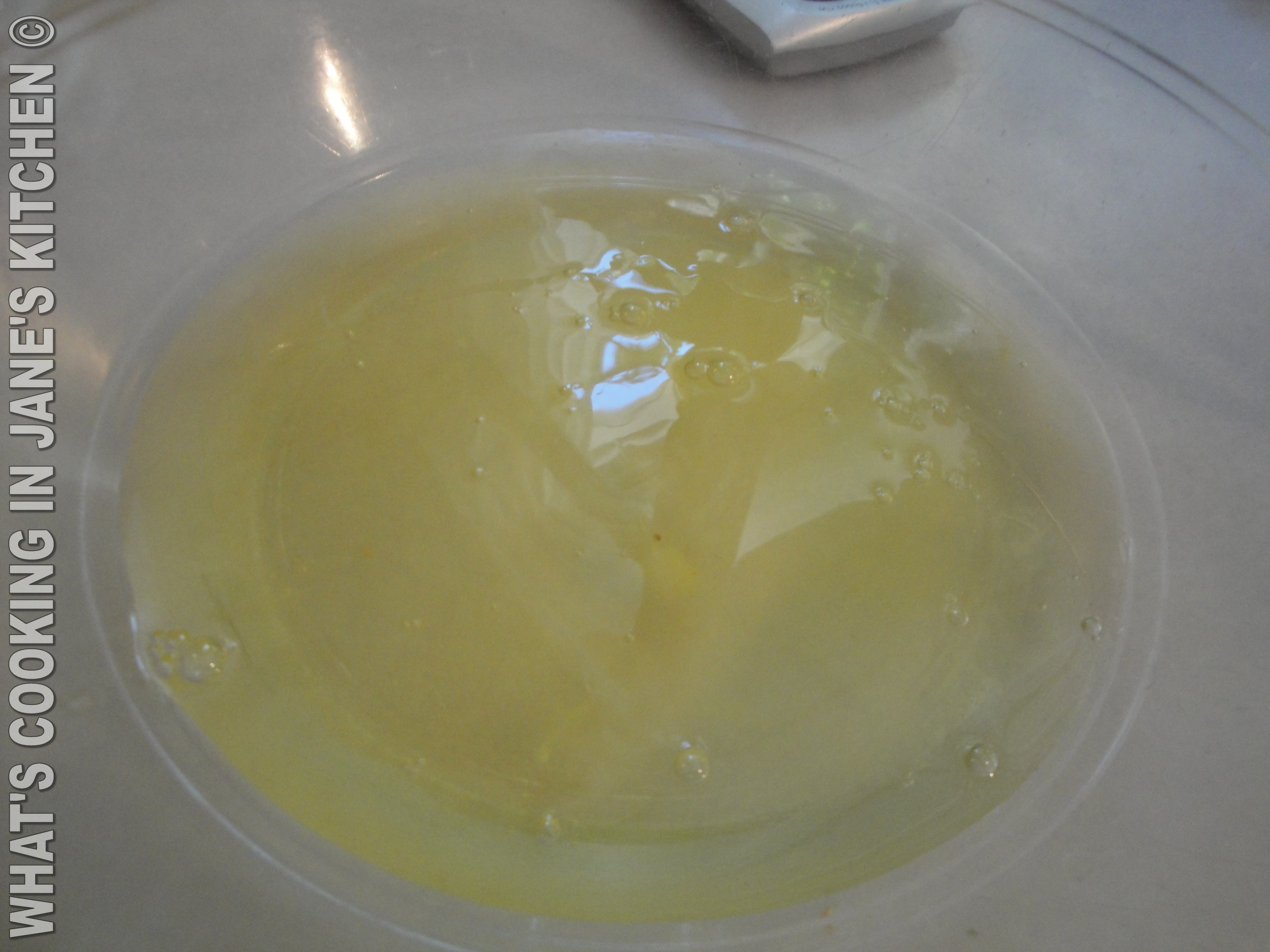
Place egg whites in spotlessly clean large bowl, big enough to fit double the volume. Add a pinch of salt,
this helps in your beating. Beat until stiff peaks. When you lift the beaters out of the meringue the peaks
should not flop over. Beat for at least three minutes at high speed.
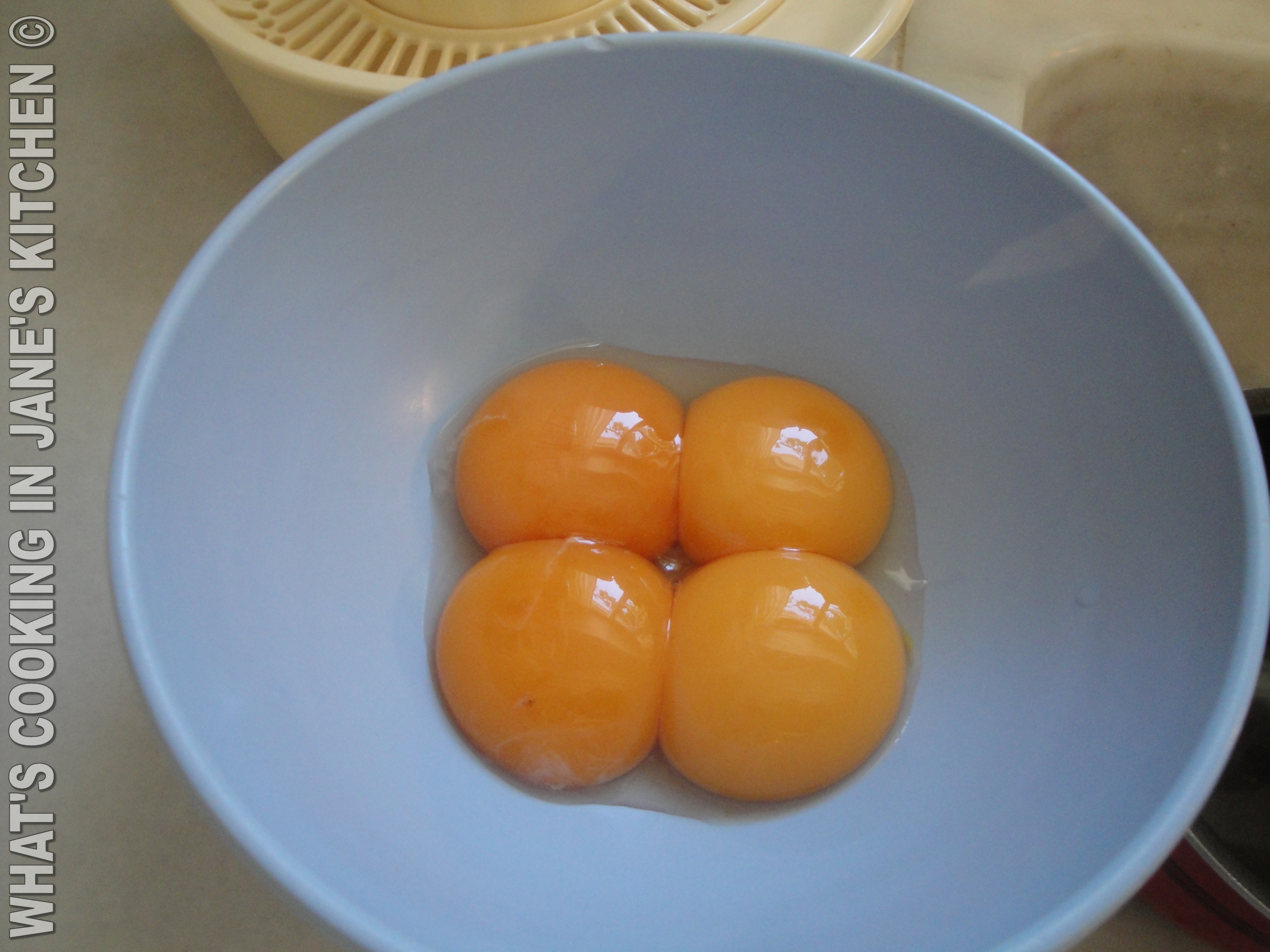
Place egg yolks in separate bowl.
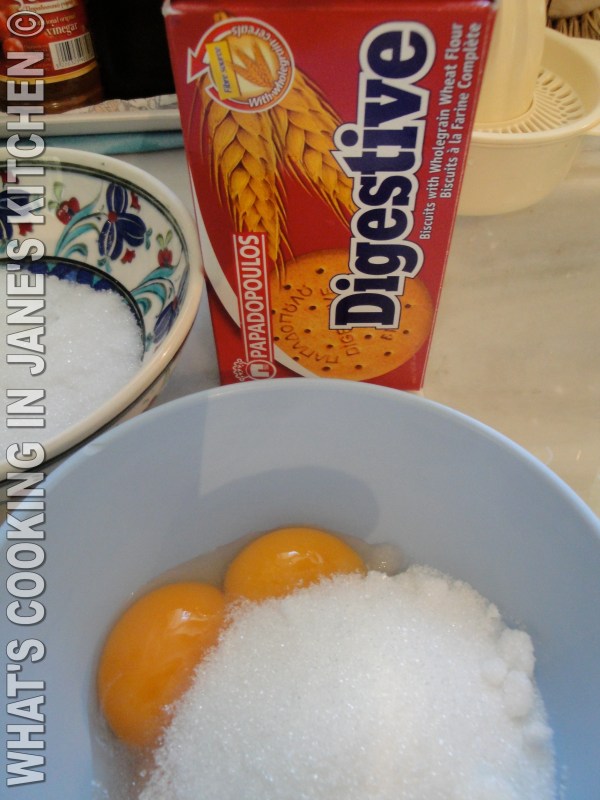
Add ’half’ the sugar.
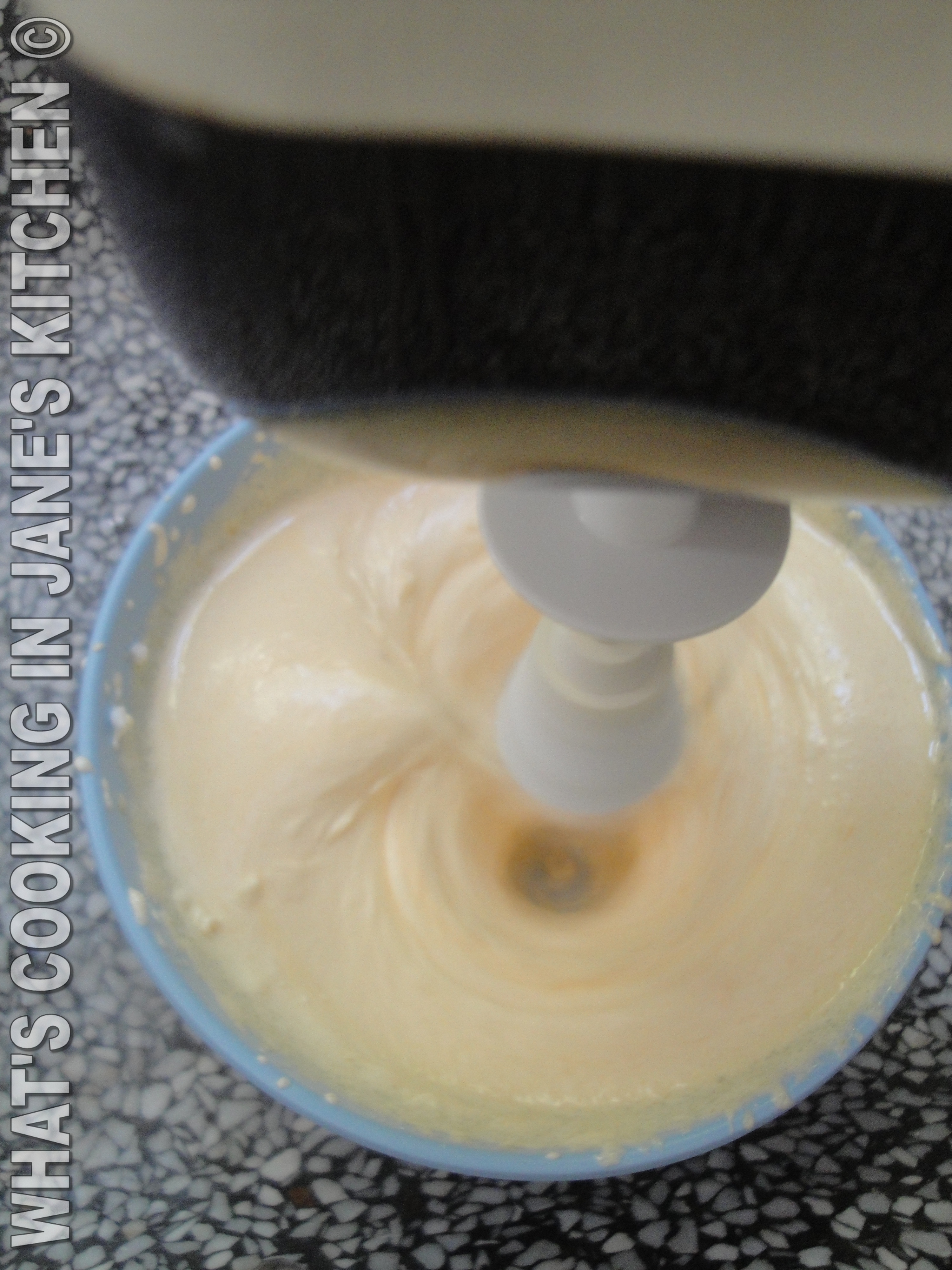
Beat egg yolks and sugar until double the volume, fluffy and pale yellow. the paler the color, the more air
that has been incorporated.
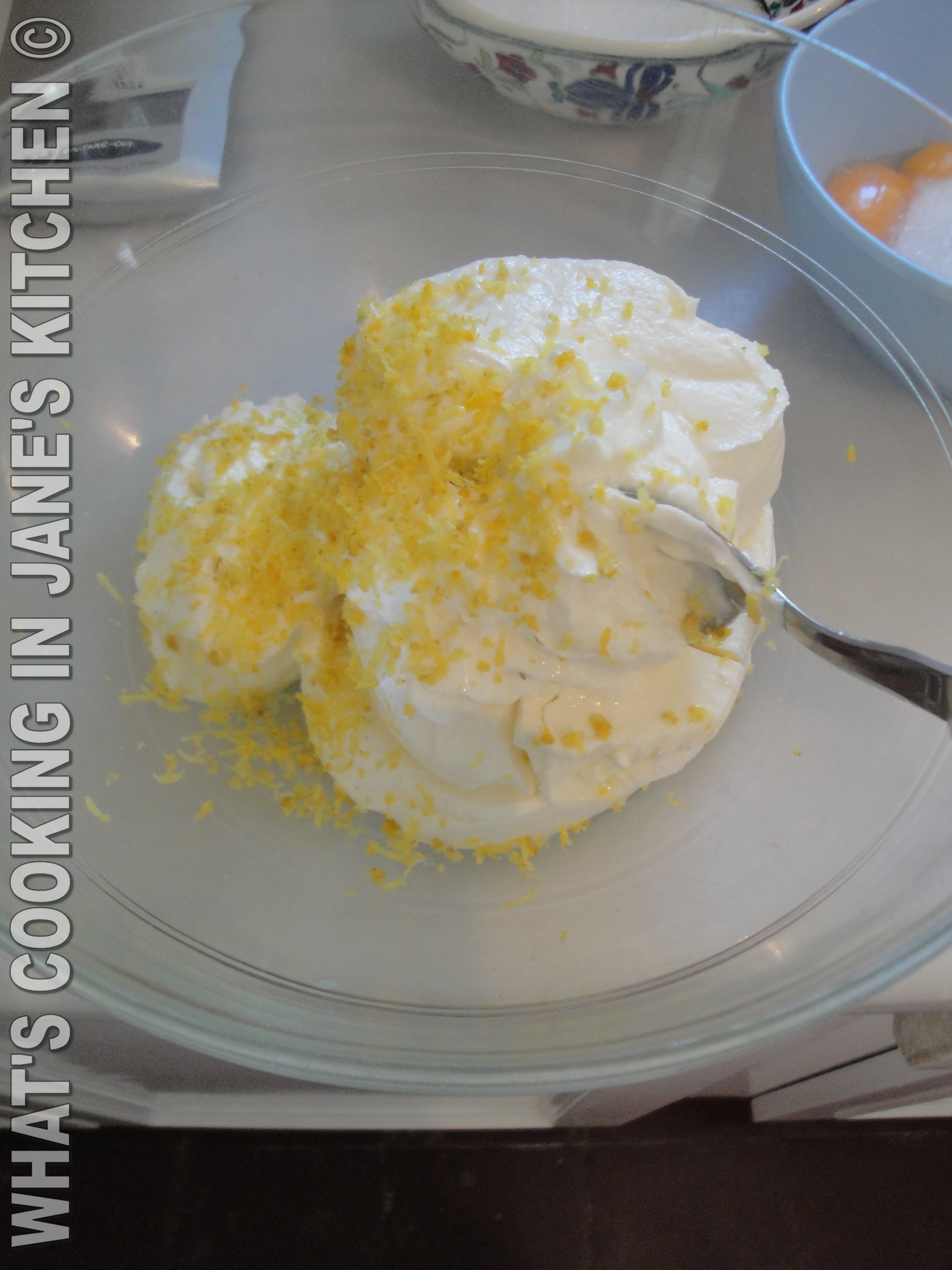
Put cream cheese into large bowl, large enough to hold final cheese cake mixture. Add yogurt and finely
grated lemon zest. Mix with a whisk until completely smooth and with out any small lumps.
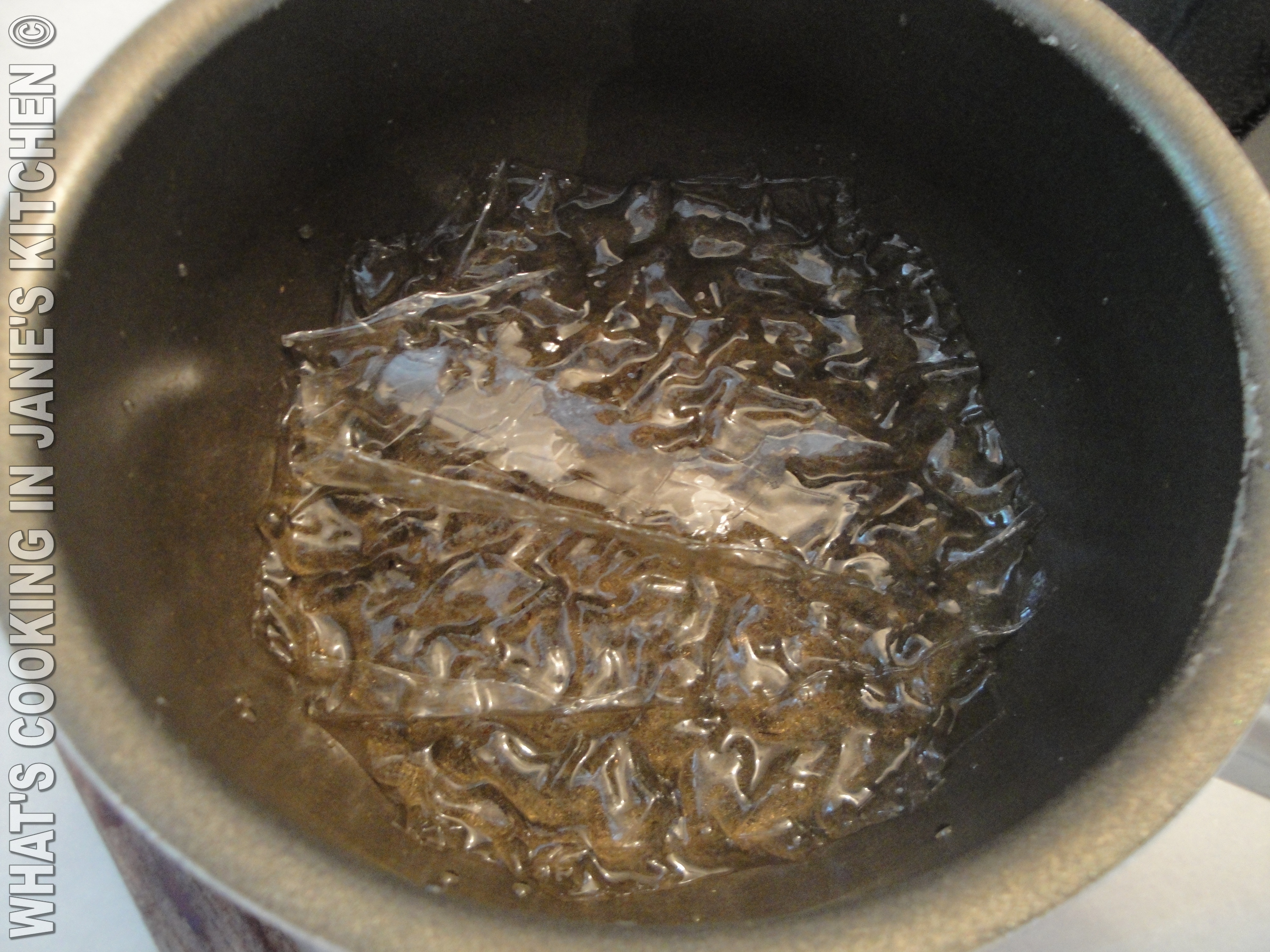
Add to small sauce pan 2-3 tbs of water. Place gelatin leaves in one by one , so that the water goes in between
the leaves and allow to soak five minutes to soften. When ready to use, melt on low heat until completely
dissolved. Do not allow to boil, or the gelatin will not gel as well.
Add your lemon juice and pour through ‘sieve’ onto beaten egg yolks 9 The sieving is important to omit any
gelatin lumps.). Mix with a hand whisk and pour over cream cheese. Whisk until thoroughly amalgamated.
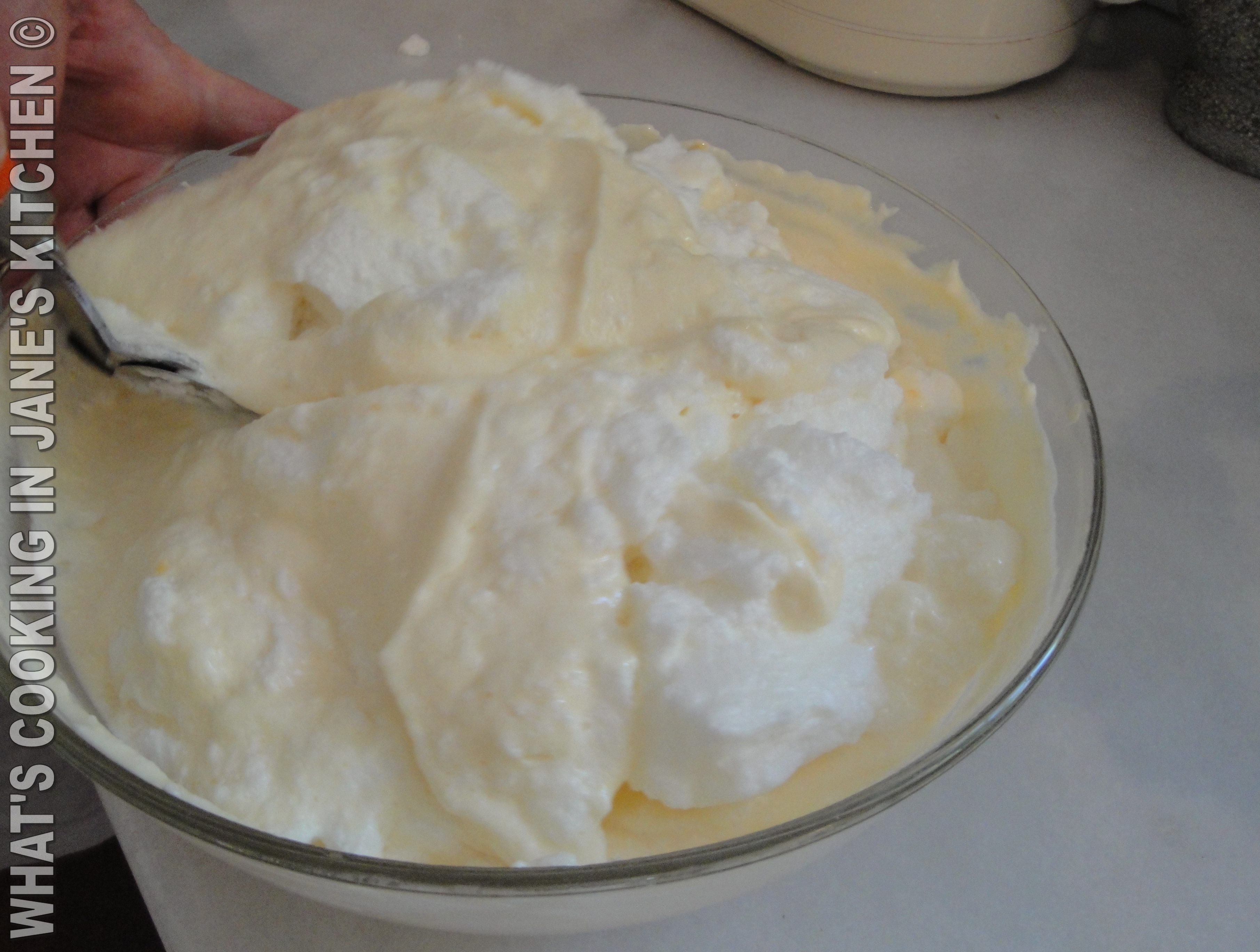
Fold in 2 tbs of meringue to cheese mixture and then fold in rest of meringue in two halves.
The folding process is important. Use a large spatula or tablespoon, cut across mixture, turn your spoon
and lift and fold over very lightly with out pressing down. Each time you do this, give the bowl a half turn.
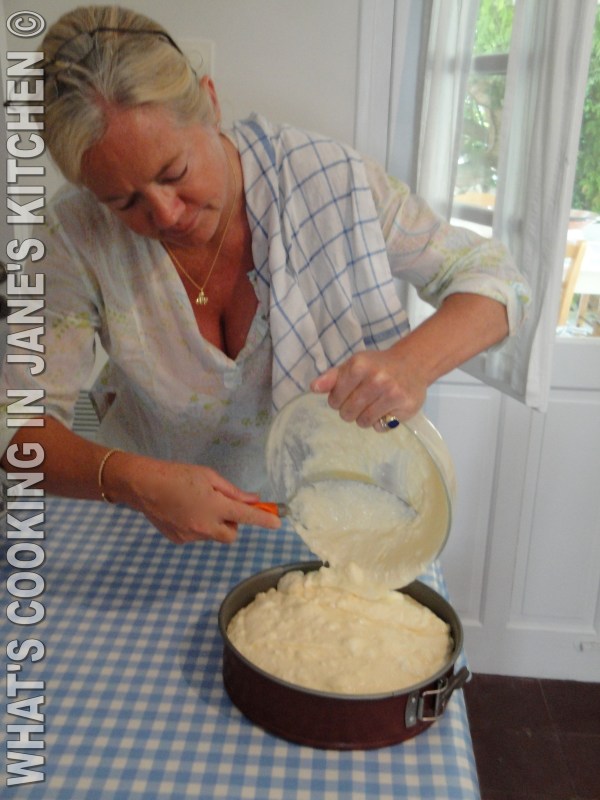
Turn out in one, into cake tin. This is also important, so as not to loose air. Smooth out gently on top and
place in refrigerator for at least four hours covered with tin foil. Here you can see the kind of spatula I use,
which is perfect for the job, as is the spring-sided cake tin.
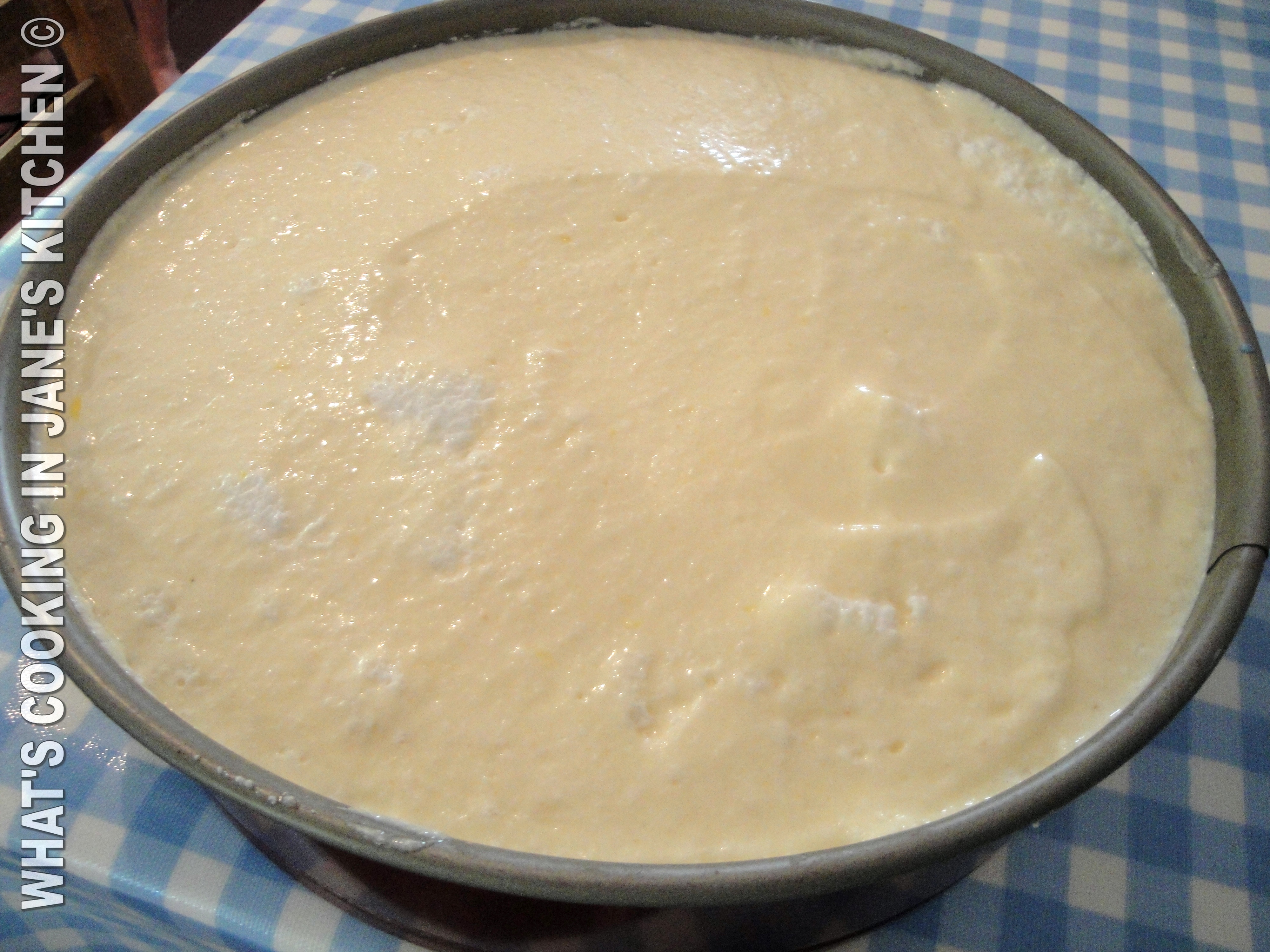
Smooth out on top. Once set, run sharp knife around inside of tin, right to the bottom, so that the biscuit does
not remain stuck to the tin and undo spring.
The cheese cake will gently drop down. Using a palette knife slide it in between the grease-proof paper and the
bottom of the tin and push gently onto serving plate, together with the grease-proof paper.
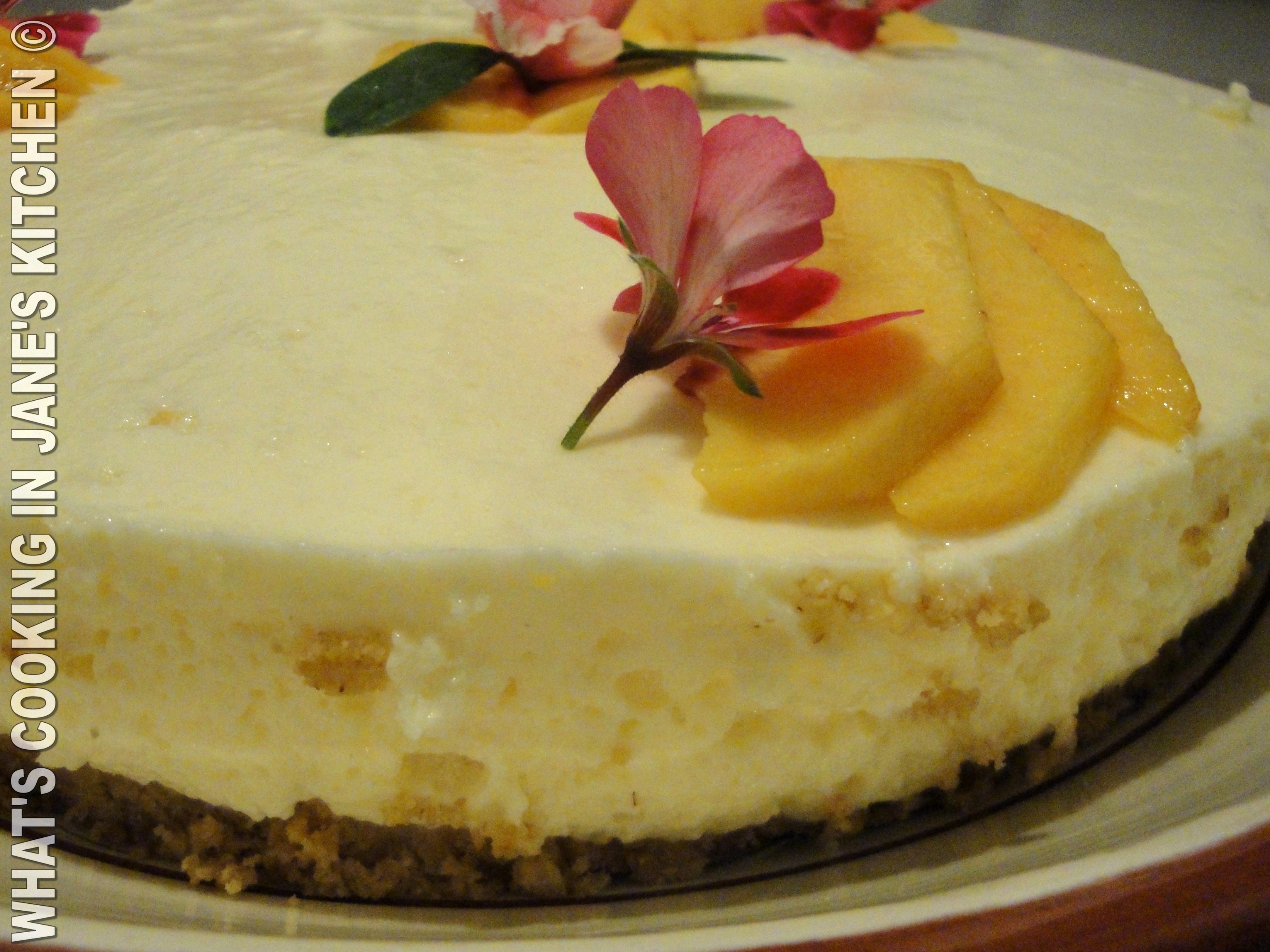
Decorate just before serving with sliced peaches, cherries and edible flowers.
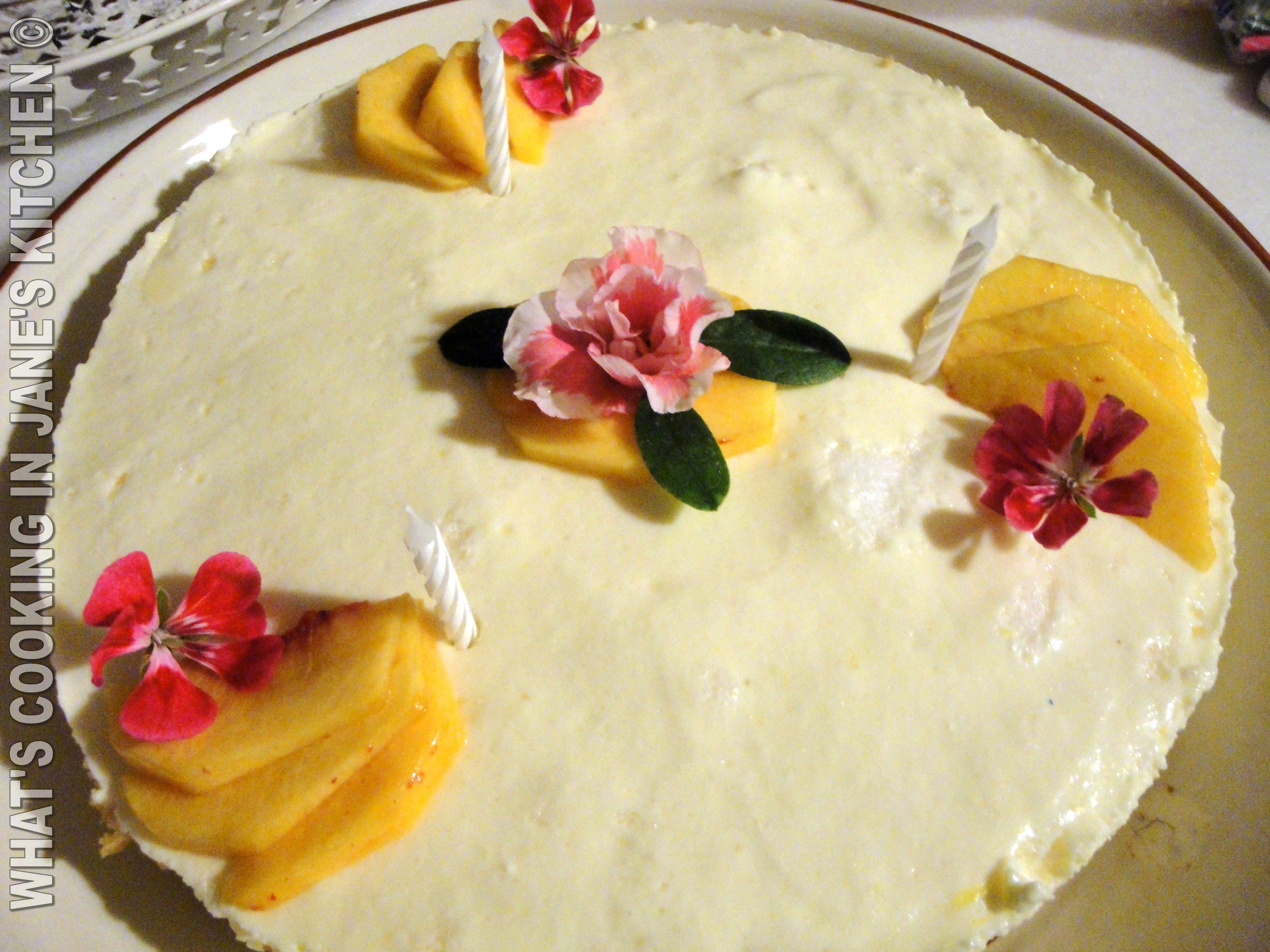
Final result…..makes an excellent Birthday Cake!
Dolmades Yalantzi ©
Previously you will have seen a similar posting to this, but that was “Dolmades Avgolemono,” with meat and egg and lemon sauce.
These dolmades are without meat and are excellent!
They are made with blanched or fresh vine leaves, filled with an aromatic rice mixture, containing sautéed spring onions, fennel and mint, pine nuts currants and raisins.
They can be eaten as part of a Meze, or as part of a Buffet. They are eaten cold, drizzled with a little olive oil and lemon juice and fill your taste buds with a wonderful combination of sweet and sour.
They were popular throughout the Ottoman Empire, these classic stuffed vine leaves are a familiar sight in Greece, parts of the Middle East and the Balkans. Yalanci, meaning ‘false’, because they contain no meat and are elegant fingers, whereas the meat filled ones are larger in size.
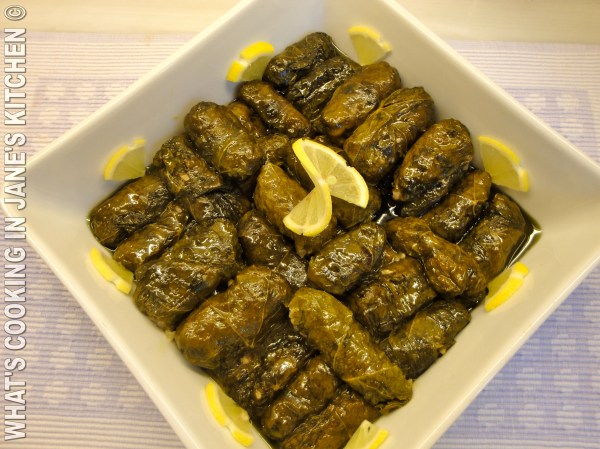
Easy, but a little time consuming……well worth the trouble though!
This quantity makes about 21 small mouth sized pieces.
You should calculate at least 4 pieces per person as they are small and delicious and excellent the next day!
Preparation time 1 hour
Cooking time 1/2-3/4 hour
Ingredients
1 jar of vine leaves in brine, or fresh leaves collected at the beginning of season. ( Use large leaves to line saucepan and cut away a little of the central stalk, when wrapping, if it looks tough!)
150 g of glacé/patna / pearly short grain rice
6-8 spring onions finely chopped
1 medium onion
2-3 tbs fresh mint leaves
6 tbs or more of fennel leaves
50 g currants
50 g raisins
50 g pine nuts
4-6 tbs olive oil
salt 2-3 tsp, pepper
300 ml stock/ or water
25 g butter (opt)
3 lemon juice
2 lemons one cut into quarters and the other sliced for decoration.
Accompany with a bowl of thick Greek Yogurt!
Method
1. Take vine leaves carefully out of jar, with the help of a long spoon and place in colander. Rinse under the running tap and blanch for two minutes in simmering water. Remove and rinse again under cold water. Drain well in colander.
2. Finely chop onion and spring onions, including some of the green leaves.
3. Finely chop the fennel stalks and add these to the onions. Finely chop the fennel leaves and keep separate. Finely chop the mint leaves and reserve.
4. Measure out the pine nuts, currants and raisins and chop briefly.
5. Add 4 tbs of oil to your saucepan and sauté, onion, spring onions and fennel stalks for five minutes (do not brown.) Then add the rice, toss in the oil and add the herbs, pine nuts and currants and raisins, 2 tsp salt and freshly ground black pepper. Add the juice of two lemons and 1/2 cup of water and cook over a medium heat, until the water has been absorbed, do not let it brown on the bottom, this can happen due to the sugar in the currants. Taste and adjust seasoning.
6. Choose a medium sized saucepan and line with some of the rougher or damaged vine leaves.
7. Unraveling your leaves carefully, spread out one leaf on a chopping board stalk side upwards and place in the centre a small teaspoonful of rice mixture. Proceed to fold as shown in the pictures and end up with a light squeeze to seal your ‘Dolma.’ Place in saucepan, one next to the other and proceed to an upper layer if necessary. Ideally you end up with two layers closely packed.
8. Cover with another layer of vine leaves, pour over your stock or water, enough to just cover, sprinkle with salt and pepper and add one lemon juice. Drizzle with a little olive oil and add a little butter for flavour, optional. Cover with a round of grease-proof paper.
9. Finally cover with a plate upside down for weight and place over a medium heat. Bring to the boil and simmer for 1/2 to 3/4 of an hour. Remove one dolma to test and if tender and rice is fully cooked, leave off the heat to cool completely. Leaves should be tender, not chewy and rice cooked. If in doubt, leave a little longer.
10. Once warm or cold, remove plate and vine leaves and arrange carefully your dolmades in a serving dish. Do not hurry this, as you don’t want to unravel the dolmades. Having washed ones hands, using ones fingers to do this is best. Important, if you do this while they are still hot the leaves blacken and dry out. Drizzle with a little beaten olive oil, together with lemon juice and a little salt. Decorate with lemon quarters and lemon slices.
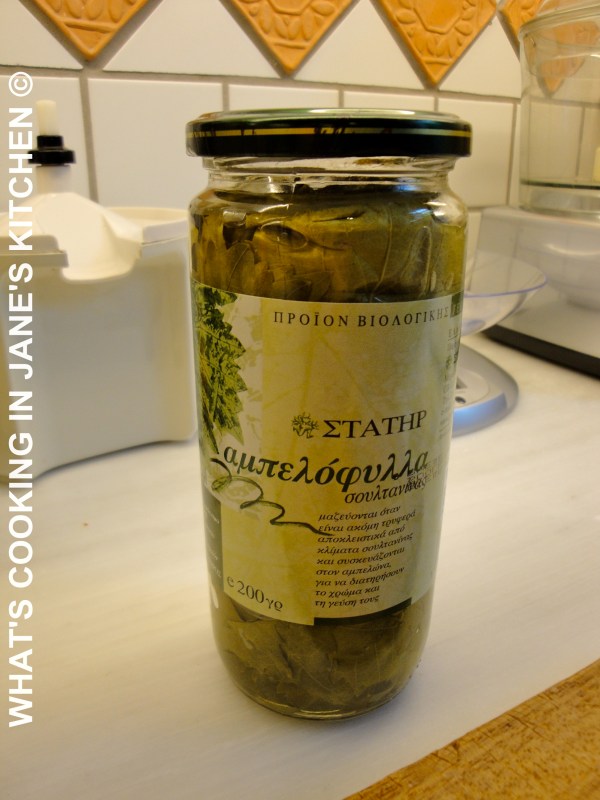
Vine leaves. ( Out side Greece, available in Greek Food Shops, or Specialised Food Shops.)
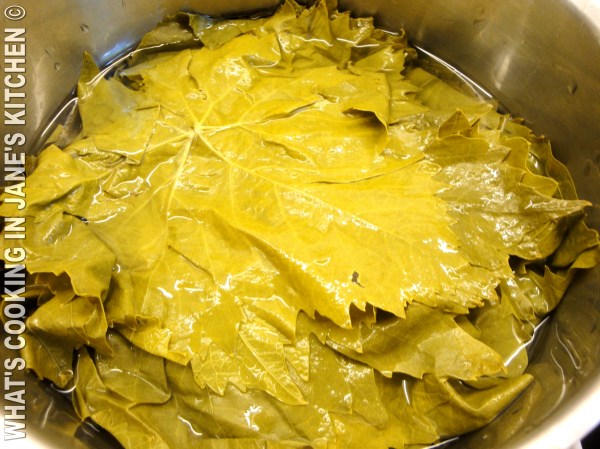
Blanch for three minutes in simmering water. Refresh under cold water and drain well in colander.
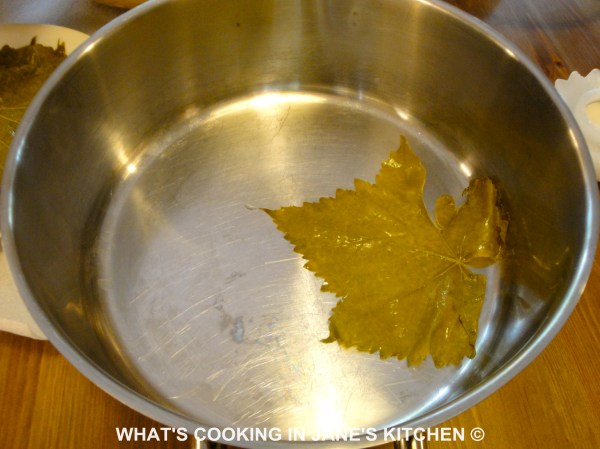
Line base of saucepan to prevent burning. Use damaged or coarser larger leaves.
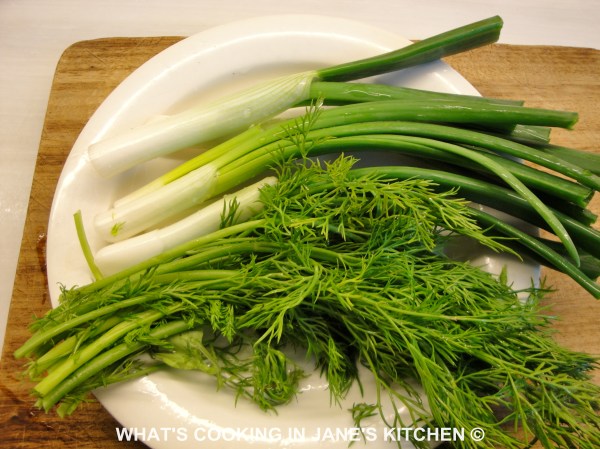
Finely chop spring onions and fennel stalks. Separately, finely chop the leaves.
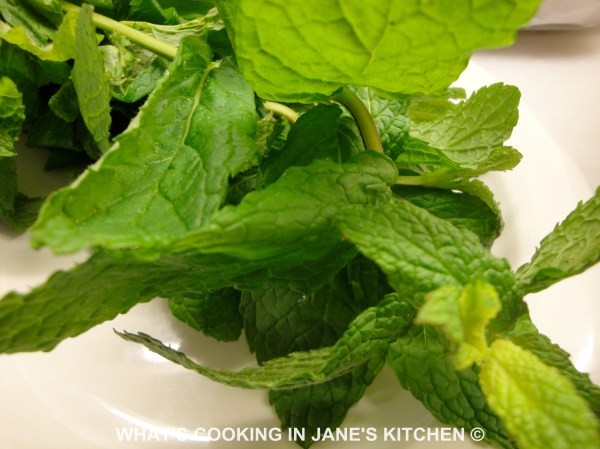
Pluck mint leaves off stalks and chop finely.
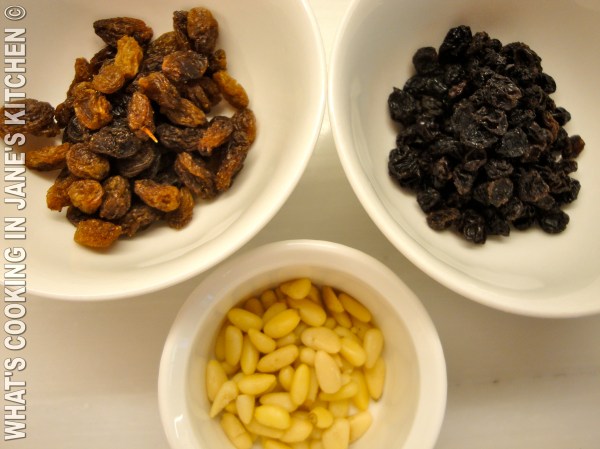
Measure out raisins, currants and pine nuts.
Sauté onion, spring onions and fennel stalks in 4 tbs of olive oil for 5 minutes, add rice and toss in oil. Add chopped herbs, raisins, currants and pine nuts. Add 1 cup of water and 1 lemon juice, seasoning. Cook gently until the water is absorbed and looks like the picture below. Taste for seasoning.
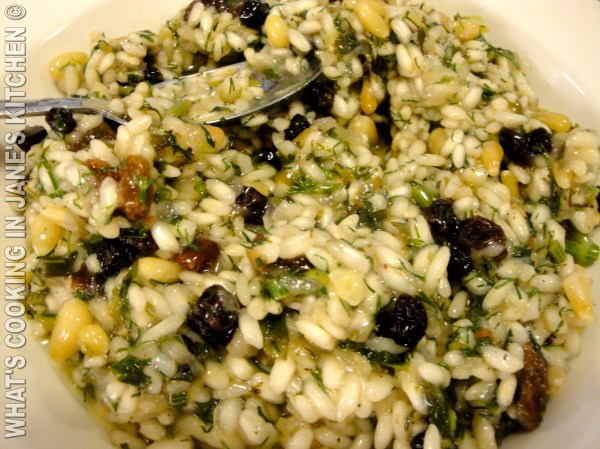
Your filling is now ready to use. ( Rice will not be fully cooked)

Lay vine leaf out on large plate or chopping board, stalk side upwards.
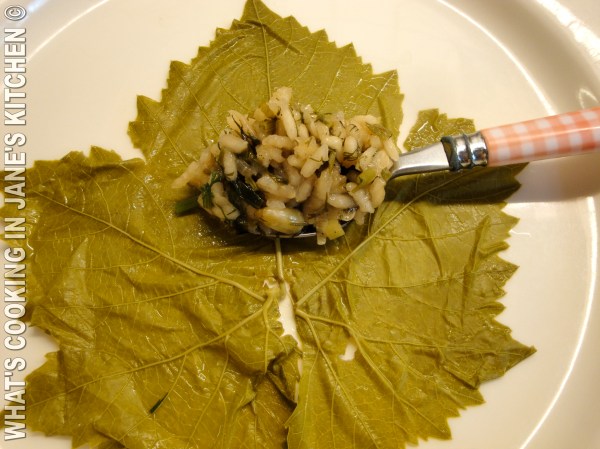
Place in center one teaspoon of stuffing, not more as you want the end result to be mouth sized and they will swell a little in the cooking.
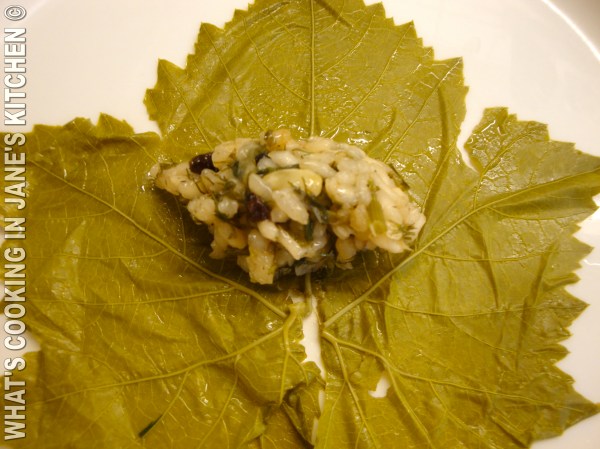
Now begin to fold, folding the lower part of the leaf over the filling.
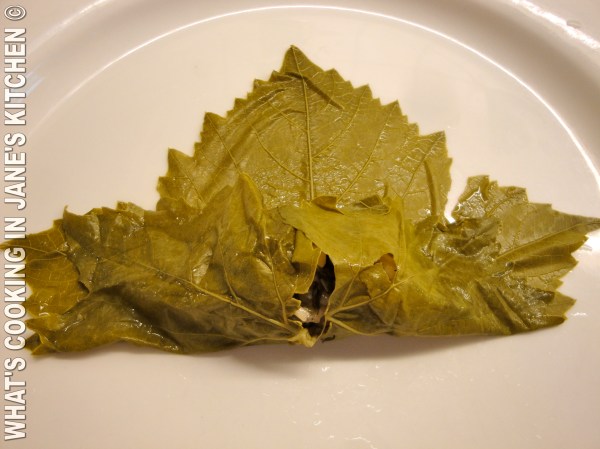
……like so.
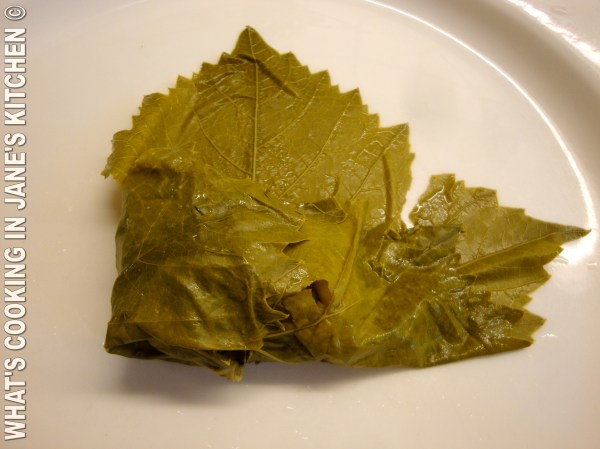
Then fold over the left side.
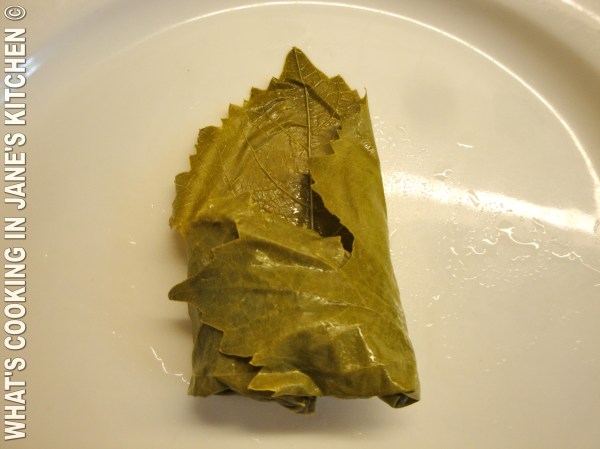
…and then fold over the right side.

Finally roll up into compact small parcel.
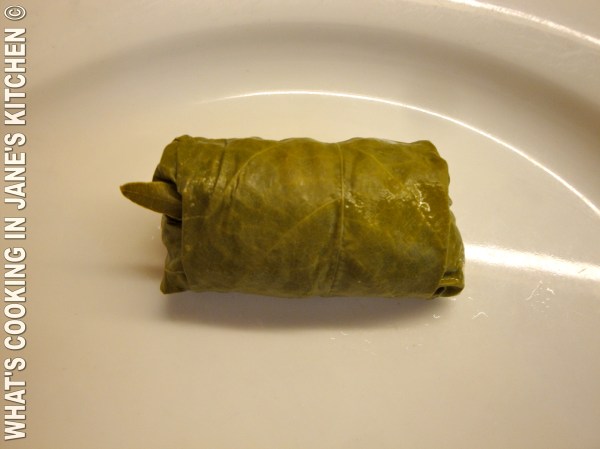
Give the dolma a gentle squeeze in the palm of your hand to seal it.
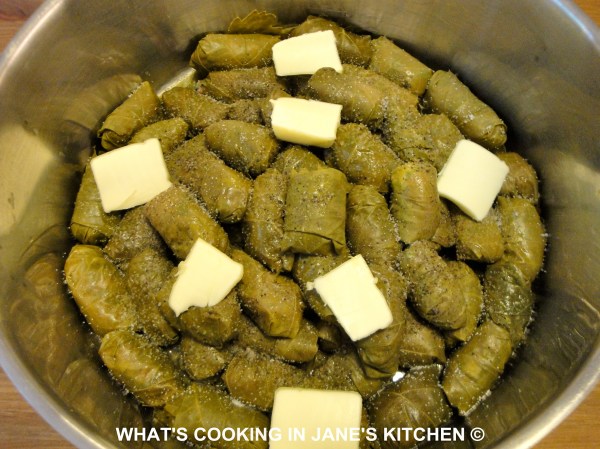
Pack closely together in saucepan, having lined the base with leaves. Form a second layer if necessary. Season, drizzle with a little olive oil
and the juice of one lemon. Pour over stock which should come to just cover the dolmades. If you are making the
dolmades for vegetarians or during a fasting period, add water instead of stock. (Omit butter too if making during lent.)
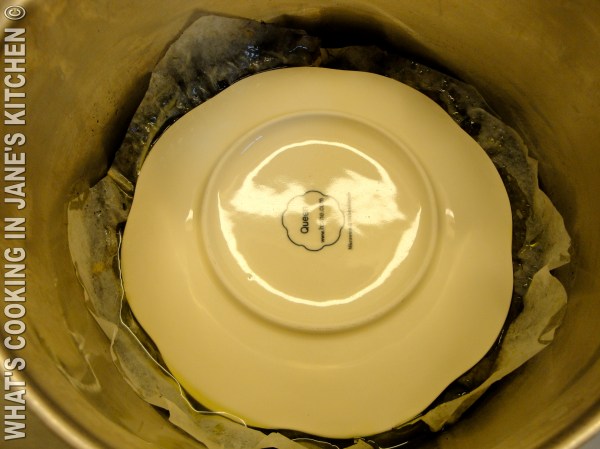
Cover with a layer of vine leaves, followed by a round of grease-proof paper. Then place on top a plate, which
weighs down the dolmades and helps them keep their shape.
Once cooking time is up, 1/2 to 3/4 hr, remove one dolma to try. Rice must be completely cooked, leaves tender, not chewy
and they should melt in the mouth. Leave a little longer if you are in any doubt.
Do not uncover until just warm or cold. Arrange on serving dish and drizzle with a mixture of olive oil and
lemon juice salt and pepper. Cover with cling film until ready to serve. Decorate with lemon.
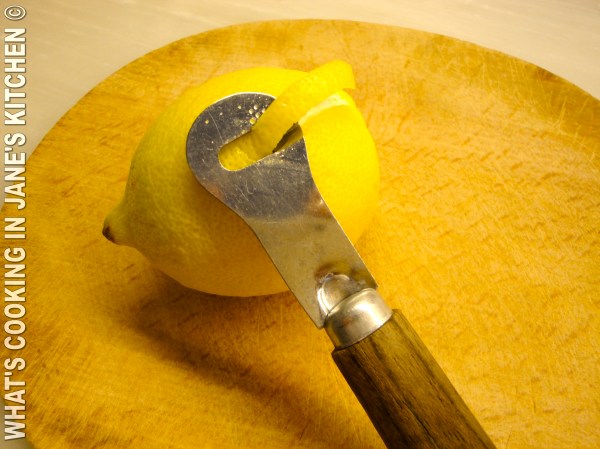
Using a Channel knife, cut three or four grooves down your washed lemon.
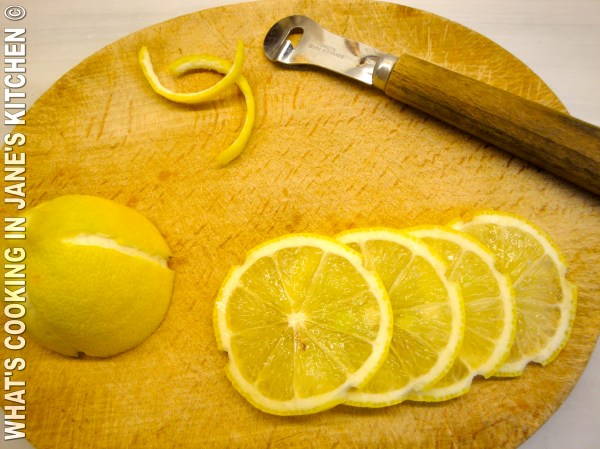
Cut thin slices for decoration.
Use another lemon and cut into quarters to serve along side for those that would like extra lemon.
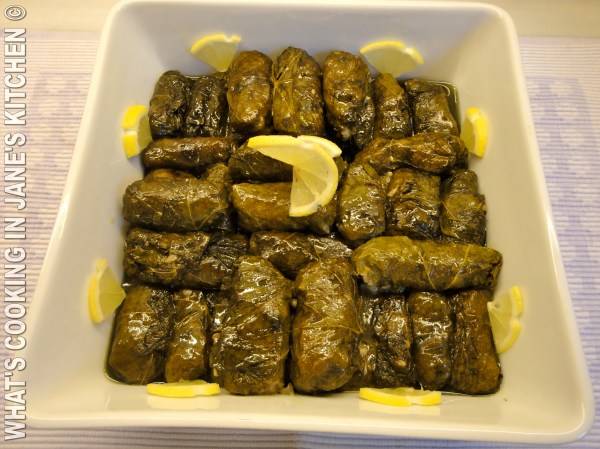
Final result.
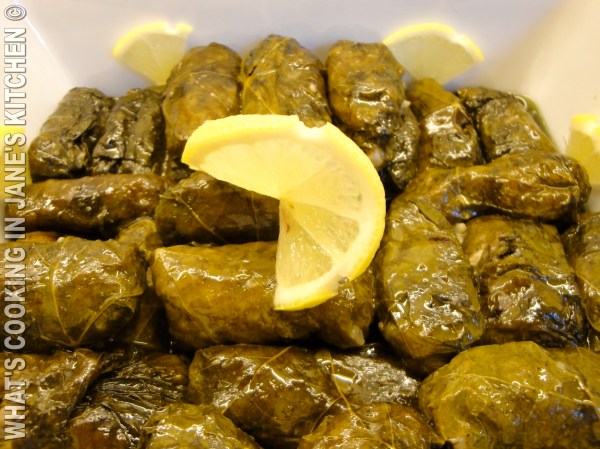
Delicious…..and excellent served with a bowl of Greek thick Yogurt.
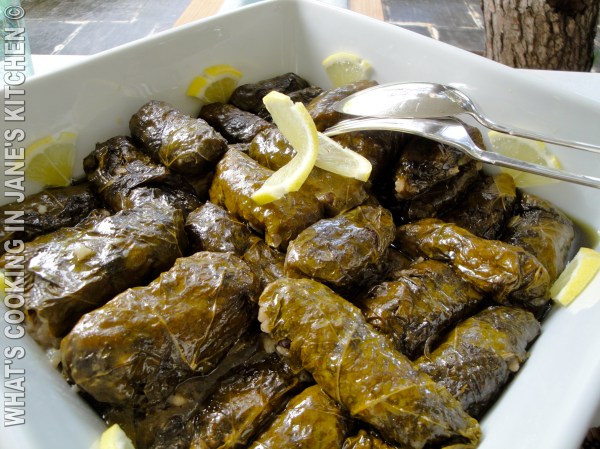
Lovely in the summer and in the winter time!
Greek Veal Stifado ©
This is a wonderful Greek recipe using veal or rabbit traditionally and baby onions.
A wonderfully warming winter dish, perfect with mashed potatoes and was my dear father’s favorite.
So dear Cousin, your request is most appropriate, following in the ‘R’ family tradition.

Easy
6 Persons
Preparation time 20 minutes
Cooking time: 1 hour
Ingredients
1 kilo Good stewing steak cut into 1″ cubes.
A little seasoned flour, (2tbs Flour, 1tsp salt, pepper)
1 kilo small baby onions
6 cloves garlic
2 tsp tomato puree
4 Bay leaves
6 cloves
6 All spice berries
2″ piece of cinnamon
2 tbs vinegar
2 tbs red wine
2 tbs Brandy
Salt Pepper
3-4 tbs Olive oil
Rosemary to garnish
Serve with mashed potatoes , broccoli and saute carrots
Method
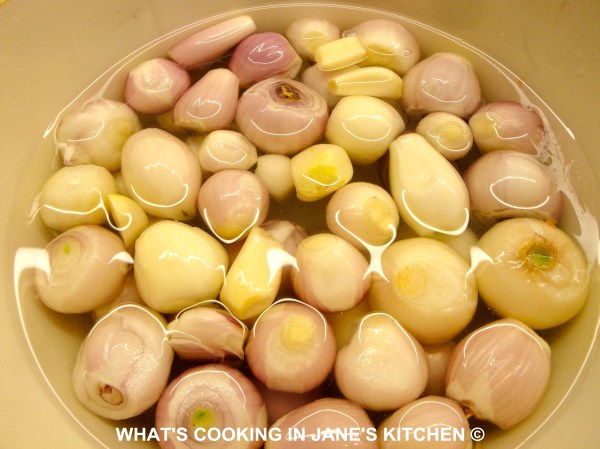
1. Put your onions and garlic in a large bowl and cover with boiling water. Leave to soak for 20 mins.
2.Peel, rinse and add to large saucepan. Drizzle with oil and toss over high heat, until beginning to brown. Remove with a slotted spoon and keep to one side.
3. Trim meat if necessary, of any excess fat or gristly bits. Toss in the seasoned flour and place in the same saucepan the onions were cooked in previously. Seal on all sides. Return onions to saucepan and add spices, toss and add alcohol.
4. Cook for two mins, so that alcohol evaporates and add tomato puree which you have diluted with a little water in a glass.
5. Simmer with lid on for 1 hour, or until onions are soft, but not disintegrated and meat is tender. (Check this by sticking a fork into the center of the meat and onions.)
6. Check for seasoning. Serve in pre-heated serving dish, accompanied by mashed potatoes and broccoli or Vichy carrots.
This is a wonderfully warming and delicious winter dish!
N.B. “Sealing the Meat” means to briefly cook it, just enough for the meat to brown, 1-3 min. This keeps the juices in the meat.
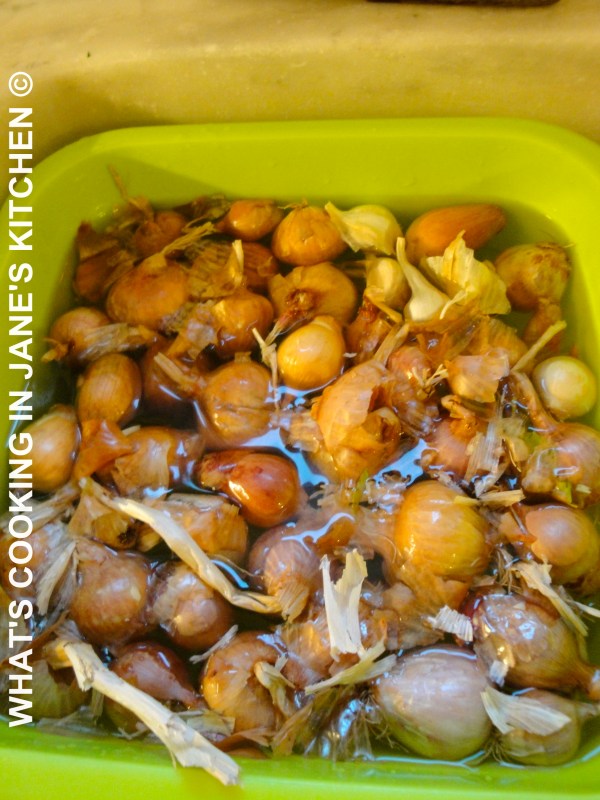
Place small onions and garlic in basin and cover with boiling water. Leave to soak for 20 minutes and then
peel. The hot water makes the onions and garlic much easier to peel.
Rinse and add to oiled saucepan.

Fry in oil until lightly browned.
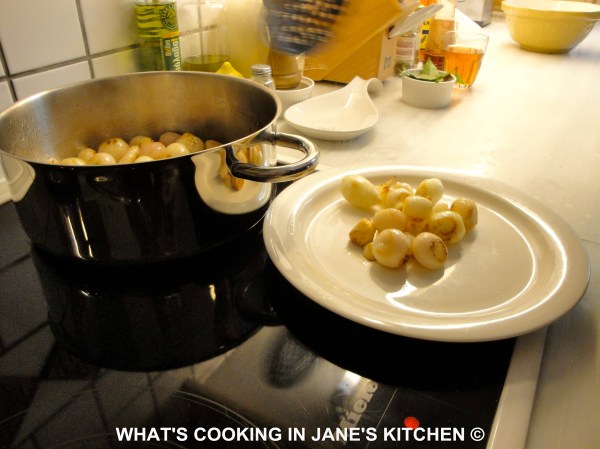
Using a slotted spoon, remove onions onto a plate, before sealing meat.

Add 3cm cubed veal to hot oil and seal on all sides. This takes about 4 minutes on a high heat.

Here you see the cubes of meat nearly all sealed.
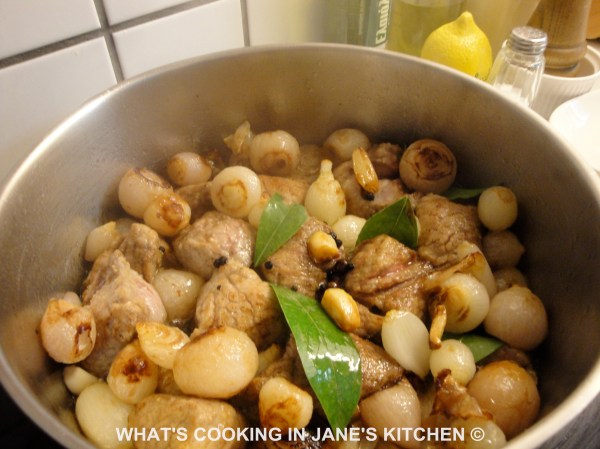
Once meat is sealed, add spices and onions.

Add diluted tomato puree, which you have diluted with a little water and pour over meat.
Leave to gently simmer, lid on for an hour. Check periodically, incase a little extra liquid is required.
Taste for seasoning and test doneness with the point of a knife. When ready meat should be tender and
onions soft, but still whole.
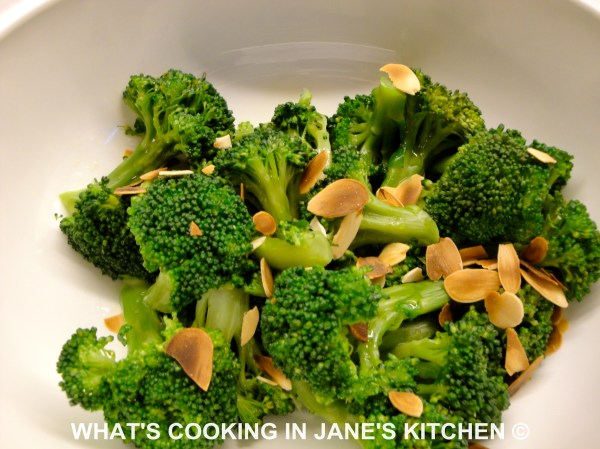
Boil broccoli florets in salted water, lid off for 8-10minutes, until just tender when you pick with the point
of a knife. Drain, place in preheated serving dish and sprinkle with almond slivers, olive oil or butter and
just before serving salt and black pepper. Don’t add salt before it will discolor broccoli and don’t keep
warm in oven, it will go soggy and dark green!
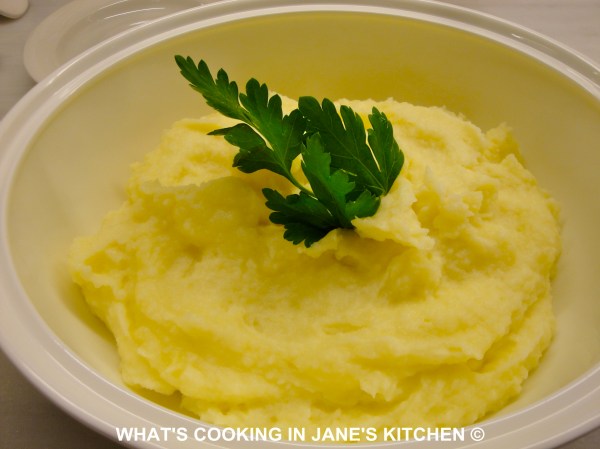
Serve with mashed potatoes: 2 medium sized potatoes per person, boiled and mashed with butter salt and
pepper and a dash of milk. Serve in pre-heated serving dish. Decorate with parsley just before serving.
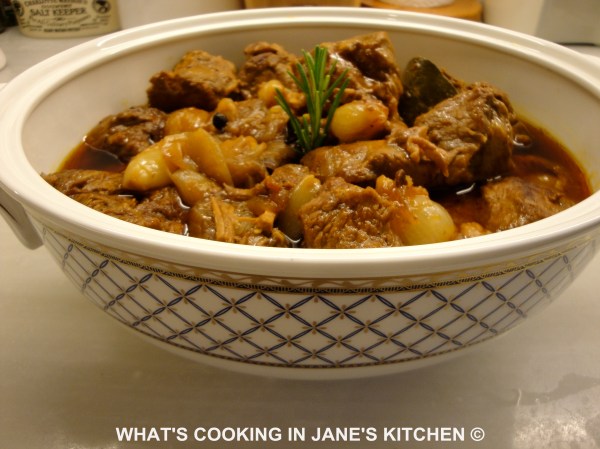
Final result! Garnish with a fresh sprig of rosemary.
 What's Cooking In Jane's Kitchen